
Easy eBooks
eBook BuilderLibrary
Graded books open for learning. Read instantly below.
Language
CEFR Level (Difficulty)
Genre / Theme
Reading Status

B2FR-EN
This analytical study offers an accessible, rigorous exploration of Simone de Beauvoir's existential philosophy and feminist theory tailored for B2-level French readers. Across fifteen focused sections, it examines her groundbreaking insights into embodied consciousness, ethical ambiguity, gender construction, and the vulnerability of aging. By anchoring abstract ideas in concrete lived experience, the work demonstrates how Beauvoir's demand for freedom and solidarity remains urgently relevant in contemporary debates.
B1FR-EN
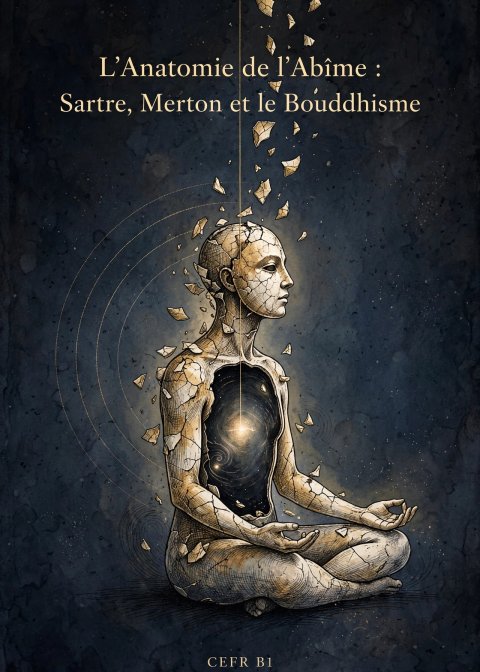
An accessible B1-level analysis of existential dread as the collapse of the curated ego. It compares Sartre's radical freedom and self-invention, Merton's purgative death of the false self toward divine ground, and Buddhism's view of clinging to a separate self that never existed.

B1TH-EN
This analytical essay dissects existential dread as the collapse of the curated ego, comparing three profound diagnoses: Sartre's radical freedom demanding self-invention, Merton's purgative death of the false self opening onto divine ground, and Buddhism's view of dread as an epistemic error — the panic of clinging to a separate self that never existed. Written in accessible Thai for CEFR B1 readers, each of the ten sections builds the argument step by step, from the anatomy of the constructed self to three distinct paths out of the same abyss.

B2FR-EN
This analytical booklet dismantles the myth of AI as a mere stochastic parrot, showing how neural networks build world models, generalize, and solve unseen problems. Comparing biological and synthetic learning, it separates consciousness from comprehension while honestly examining embodiment, hallucinations, and limits. It proposes a new definition of understanding for an age of alien, geometric intelligence.

B2EN
Is AI just a parrot repeating our words? This clear B2-level analysis breaks down how neural networks learn, generalize, and solve unseen problems. It compares human and machine learning to argue for a new, synthetic form of understanding.

B1FR-EN
A B1-level analytical work in French exploring themes from Magnifica Humanitas and the ethics of AI. It examines human uniqueness, private monopolies, labor exploitation, disinformation, and autonomous weapons, arguing technology must serve human rights and equity.

B1TH-EN
A practical expository guide for high-achieving students on building durable emotional resilience. It explains six research-based tools — from Linville's self-complexity and Neff's self-compassion to Simon's satisficing, Kross's distancing, stress reframing, and dismantling pluralistic ignorance — in clear B1-level Thai.

B1EN
This practical guide explains why top students feel so much pressure when grades become their only source of worth. It teaches six clear, science-based tools to stay calm, protect identity, and study without burnout.

B1TH-EN
This expository work maps the five core mechanisms of Yale's Science of Well-Being course onto foundational Buddhist concepts, showing that cognitive science and contemplative philosophy arrive at the same diagnoses and solutions through different methods. Written in accessible Thai for CEFR B1 readers, it covers hedonic adaptation, miswanting, rewirements, savoring, and altruism alongside anicca, taṇhā, bhāvanā, sati, and mettā. The final chapters honestly address the fundamental divergence between secular well-being and the Buddhist goal of complete liberation.

B1EN
Yale's famous "Science of Well-Being" course and 2,500-year-old Buddhist philosophy reach strikingly similar conclusions about why we suffer and how to flourish. This clear, accessible guide maps Laurie Santos's scientific findings — hedonic adaptation, miswanting, rewirements, savoring, and the power of giving — onto core Buddhist ideas like impermanence, craving, mindfulness, and loving-kindness. Written for curious general readers, it shows where modern psychology and ancient wisdom agree, and where their paths meaningfully diverge.

B1FR-EN
This B1 French expository work explores hedonic adaptation — our tendency to return to a stable level of happiness — and shows how ancient philosophers like the Stoics and Epicurus grappled with the same phenomenon long before modern science named it. Each section combines clear explanations, real historical facts, and practical takeaways for everyday life.

Le bonheur et l'habitude : La leçon des philosophes anciens
CEFR A2
A2FR-EN
This short expository book for CEFR A2 French learners explores hedonic adaptation—the psychological tendency to return to a baseline level of happiness after positive or negative events. Drawing on ancient philosophy, particularly Epicurus and the Stoics, it explains why we get used to good things and offers timeless insights on how to live a more fulfilling life. Simple language and real-world examples make complex ideas accessible.
Showing 12 of 287 stories